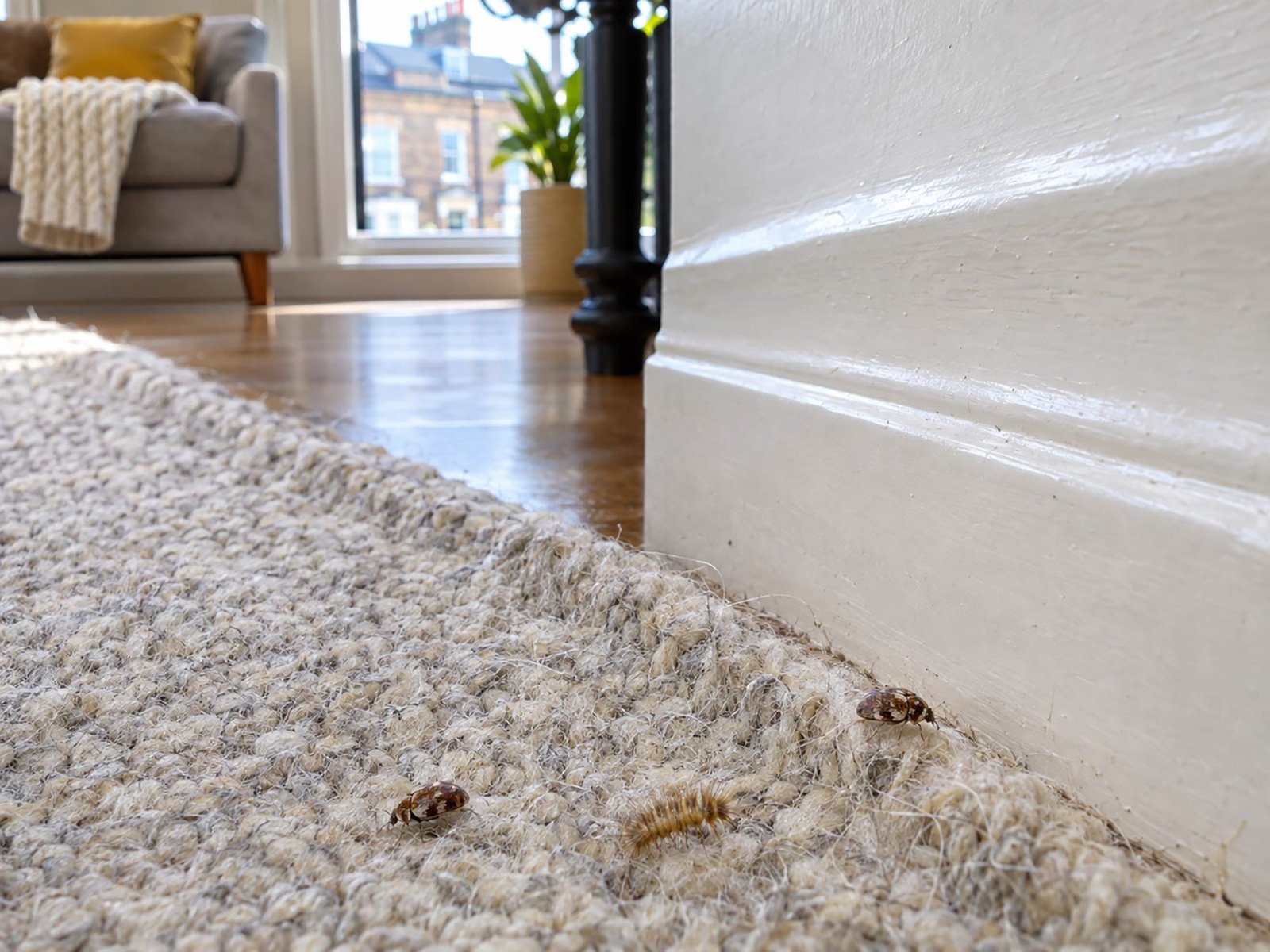
You notice a small beetle on your windowsill. A few days later, you discover tiny holes in a woollen jumper or an unusual worn patch on a rug. At first, the two things seem completely unrelated. But they could be warning signs of a hidden pest problem developing inside your home.
Carpet beetles are among the household pests that can go unnoticed for surprisingly long periods. Unlike cockroaches, rats or bed bugs, they rarely cause immediate alarm. They are small, relatively quiet and often remain hidden in places that homeowners seldom inspect.
However, carpet beetles in Dublin homes can damage carpets, clothing, upholstery and other items made from natural materials. Their larvae feed on animal-based fibres, including wool, fur, feathers and certain textiles. Left undisturbed, they may cause damage long before anyone realises there is a problem.
For homeowners, tenants and landlords across Dublin, understanding the early warning signs is essential.
At Discreet Pest Control, we understand that even the smallest household pests can become frustrating when they settle into your living space. This guide explains how to recognise carpet beetles, where they hide, why they appear and what you can do to protect your home.
Carpet Beetles in Dublin Homes: What Are They?
Carpet beetles are small insects belonging to the Dermestidae family. Several species can occur in buildings, and their appearance varies depending on the species and stage of development.
Adult carpet beetles are generally small, oval-shaped insects. Some have a mottled pattern of cream, brown, black or yellowish scales, while others appear more uniformly dark.
Because of their size, homeowners sometimes mistake them for harmless outdoor beetles.
However, the adult insects are usually not responsible for the damage found inside homes.
The real problem is their larvae.
Carpet beetle larvae are small, elongated and often covered in fine hairs or bristles. They prefer dark, undisturbed places where suitable food materials are available.
While adult beetles may feed on pollen outdoors, larvae feed on materials containing animal-derived proteins.
This difference is important because seeing an adult beetle near a window does not necessarily mean the infestation is centred there.
The real source could be beneath a carpet, inside a wardrobe, behind furniture or somewhere else entirely.

Why Carpet Beetles Appear in Dublin Homes
Dublin has a wide variety of residential properties, ranging from Victorian terraced houses and Georgian buildings to modern apartments, semi-detached family homes and newly renovated properties.
Carpet beetles can potentially establish themselves in any of these environments.
Older properties may contain natural wool carpets, wooden floor gaps, unused fireplaces, loft spaces and undisturbed storage areas. These can provide protected places for larvae.
Modern homes are not immune either. Upholstered furniture, woollen clothing, decorative rugs, pet bedding and hidden accumulations of dust or hair may provide suitable food sources.
Adult carpet beetles can enter through open windows and doors. They may also be introduced with second-hand furniture, stored textiles, rugs, clothing or other affected items.
Bird nests near roof spaces and accumulations of dead insects can sometimes provide alternative sources.
Once suitable conditions are available, carpet beetles may establish themselves without attracting attention.
This is why carpet beetle prevention in Dublin homes should involve both regular cleaning and careful inspection of vulnerable materials.
Signs of Carpet Beetles in Dublin Homes
Recognising the signs early can help prevent unnecessary damage.
One of the most noticeable warning signs is unexplained damage to natural fabrics.
You might discover irregular holes in a woollen jumper, worn areas on a rug or small patches of damaged upholstery.
Unlike ordinary wear and tear, insect damage may appear in areas that are rarely touched or used.
Another important sign is the presence of shed larval skins.
As carpet beetle larvae grow, they shed their outer coverings. These dry, brownish skins may accumulate behind furniture, inside cupboards, under rugs or around skirting boards.
You may also notice small hairy larvae moving slowly across surfaces.
Adult carpet beetles are often seen near windows because they are attracted towards light.
However, finding one adult beetle does not automatically confirm an established infestation. Repeated sightings, larvae, shed skins or textile damage provide stronger evidence that further investigation is needed.
Carpet Beetles in Dublin Homes: Signs and Prevention. Where Do Carpet Beetles Hide?
One of the main challenges with carpet beetle control is locating the source.
The larvae prefer areas that are dark, quiet and rarely disturbed.
In a typical Dublin home, these locations may include the edges of fitted carpets, underneath sofas, behind wardrobes, inside storage cupboards, beneath beds and along skirting boards.
Woollen rugs and upholstered furniture can be particularly vulnerable when they remain in the same position for long periods.
Loft spaces and unused rooms may also provide opportunities for carpet beetles to develop.
Some larvae feed on accumulations of pet hair, feathers, dead insects or other organic material.
This means that even homes without wool carpets can experience problems.
The best approach is to investigate the areas where vulnerable materials are stored, rather than focusing exclusively on locations where adult beetles have been seen.
Carpet Beetles vs Clothes Moths: What’s the Difference?
Carpet beetles and clothes moths are often confused because both can damage natural fabrics.
However, they are different insects with different life cycles and behaviours.
Carpet beetles belong to the beetle family, while clothes moths are moths. The larvae of both groups can feed on wool and certain other animal-based materials.
Carpet beetle larvae are generally hairy or bristly. Clothes moth larvae are usually smoother, pale-coloured caterpillars.
The damage can sometimes look similar, although carpet beetles may leave larger worn patches or irregular holes.
Some clothes moth species produce silk webbing associated with their feeding activity. Carpet beetle larvae do not produce this type of webbing.
Finding shed, bristly larval skins can therefore be a useful clue.
Correct identification matters because it helps determine where to inspect and what treatment approach may be appropriate.
If you are unsure whether you have carpet beetles, moths or another household insect, consider arranging a professional pest control inspection in Dublin.
Can Carpet Beetles Damage Furniture and Clothing?
Yes. Carpet beetle larvae can damage household items containing suitable animal-based materials.
Natural wool carpets and rugs are particularly vulnerable, especially in areas that are rarely vacuumed.
Woollen jumpers, coats, blankets, felt, feathers and certain upholstery materials may also be affected.
Stored winter clothing can be at risk when it is placed in wardrobes or boxes for several months without being disturbed.
However, carpet beetle larvae do not generally feed on clean synthetic fabrics such as polyester or nylon.
Damage to synthetic materials may occur when they contain animal-based fibres or significant organic residues.
This distinction helps explain why one jumper in a wardrobe might be damaged while neighbouring garments remain untouched.
For homeowners with valuable rugs, inherited furniture or expensive woollen clothing, discovering an infestation can be particularly frustrating.
Early detection can help prevent further losses.
How to Prevent Carpet Beetles in Dublin Homes
Prevention begins with removing the conditions that allow larvae to develop unnoticed.
Regular vacuuming is one of the most effective practical measures.
Pay particular attention to carpet edges, skirting boards, furniture bases, wardrobes and areas beneath heavy items that are rarely moved.
Vacuuming helps remove dust, hair, dead insects and other materials that may support carpet beetle larvae.
Cleaning should extend beyond the most visible areas of the home.
Moving furniture occasionally, inspecting the underside of rugs and checking stored textiles can make a significant difference.
Clothing made from natural fibres should be cleaned before long-term storage.
Sweat, food stains and other residues can make textiles more attractive to certain fabric pests.
Where practical, store vulnerable clothing in tightly sealed containers or protective storage bags.
Avoid placing valuable woollen items in open cardboard boxes in lofts or cupboards where they may remain untouched for months.
It is also sensible to inspect second-hand furniture, vintage rugs and stored clothing before bringing them into the house.
These habits form an important part of carpet beetle prevention in Dublin homes.
Carpet Beetles in Homes with Cats and Dogs
Pet owners may face additional challenges because animal hair can accumulate in places that are difficult to clean.
Hair often collects beneath sofas, behind furniture, along skirting boards and underneath pet beds.
These areas can provide food sources for some carpet beetle larvae, especially when combined with dust and other organic material.
Regularly washing pet bedding, vacuuming favourite sleeping areas and checking hidden corners can help reduce the risk.
It is important to understand that carpet beetles are not the same as fleas.
Fleas feed on blood, while carpet beetle larvae feed on suitable natural materials and organic debris.
If your pet is scratching frequently or you are noticing bites around your ankles, the problem may be different.
For more information, read our guide to Flea Control in Dublin Homes.
Correct pest identification prevents unnecessary treatments and helps you focus on the real source.
Can Carpet Beetles Affect People?
Carpet beetles do not feed on human blood and are not known for biting people.
However, the tiny hairs on some carpet beetle larvae can cause irritation or allergic skin reactions in sensitive individuals.
These reactions may sometimes be mistaken for insect bites.
It is important not to assume that a skin rash is caused by carpet beetles without further evidence.
Other insects, allergies and medical conditions can produce similar symptoms.
If you develop persistent irritation or unexplained skin problems, speak to an appropriate healthcare professional.
From a pest control perspective, the priority is confirming whether carpet beetles are present and identifying where the larvae are developing.
Why DIY Carpet Beetle Treatment May Not Work
When homeowners discover insects or damaged fabrics, the immediate reaction is often to purchase a general insect spray.
Unfortunately, spraying visible adult beetles may not address the source.
The larvae may be hidden deep inside textile folds, beneath furniture, along carpet edges or in accumulated organic debris.
If the source remains untreated, the problem may continue.
Another common mistake is throwing away a damaged item without inspecting the surrounding area.
The visible damage might be only one part of a wider issue.
Repeated use of unsuitable insecticides can also create unnecessary risks around children, pets and household surfaces.
A more effective approach begins with identification, inspection, cleaning and targeted control where necessary.
Professional Carpet Beetle Control in Dublin
Persistent carpet beetle activity may require a professional assessment.
The purpose of an inspection is to confirm the insect involved, locate vulnerable materials, identify likely breeding areas and determine whether an active infestation is present.
A pest control professional may recommend improved cleaning practices, removal of affected materials, better storage arrangements or targeted treatment where appropriate.
The exact approach depends on the species, the extent of activity and the layout of the property.
At Discreet Pest Control, we understand that household pest problems require individual attention.
Our team provides professional pest control services across Dublin, Kildare, Wicklow and Meath, with an emphasis on identifying pest activity and recommending practical solutions.
If you are concerned about unidentified insects damaging carpets or clothing, contact us to discuss inspection and suitable control options.
Carpet Beetles in Dublin Rental Properties
Carpet beetles can also become a concern in rental accommodation.
A new tenant may discover insects shortly after moving in, particularly where carpets, wardrobes or furniture have been left undisturbed.
Landlords and property managers should pay attention to complaints about unexplained fabric damage, larvae or repeated beetle sightings.
End-of-tenancy inspections can provide an opportunity to check carpet edges, fitted wardrobes, storage spaces and upholstered furniture.
If an infestation is suspected, correctly identifying the pest before arranging treatment is important.
Regular property maintenance and cleaning between tenancies can also help reduce the likelihood of recurring problems.
When Should You Contact Discreet Pest Control?
Finding an occasional small beetle near a window does not necessarily mean your property has a serious infestation.
However, repeated sightings combined with damaged fabrics, shed larval skins or visible larvae should be investigated.
You should also consider professional advice if valuable carpets or furniture are affected, if insects appear in several rooms, or if cleaning has not resolved the problem.
The earlier the source is identified, the easier it is to prevent additional damage.
Protect Your Dublin Home from Carpet Beetles
Carpet Beetles in Dublin Homes: Signs and Prevention
Carpet beetles are easy to overlook because they are small and often remain hidden.
However, the damage caused by their larvae can become expensive, particularly when natural wool carpets, furniture and valuable clothing are affected.
The best protection is a combination of regular cleaning, careful storage, early identification and professional advice when required.
Check vulnerable textiles. Vacuum hidden areas. Inspect second-hand items. Pay attention to shed skins, larvae and unexplained fabric damage.
Most importantly, do not ignore repeated warning signs.
If you are concerned about carpet beetles in Dublin homes, contact Discreet Pest Control for professional advice.
We help homeowners, tenants and property managers across Dublin and surrounding counties understand pest problems and take the appropriate steps towards effective control.